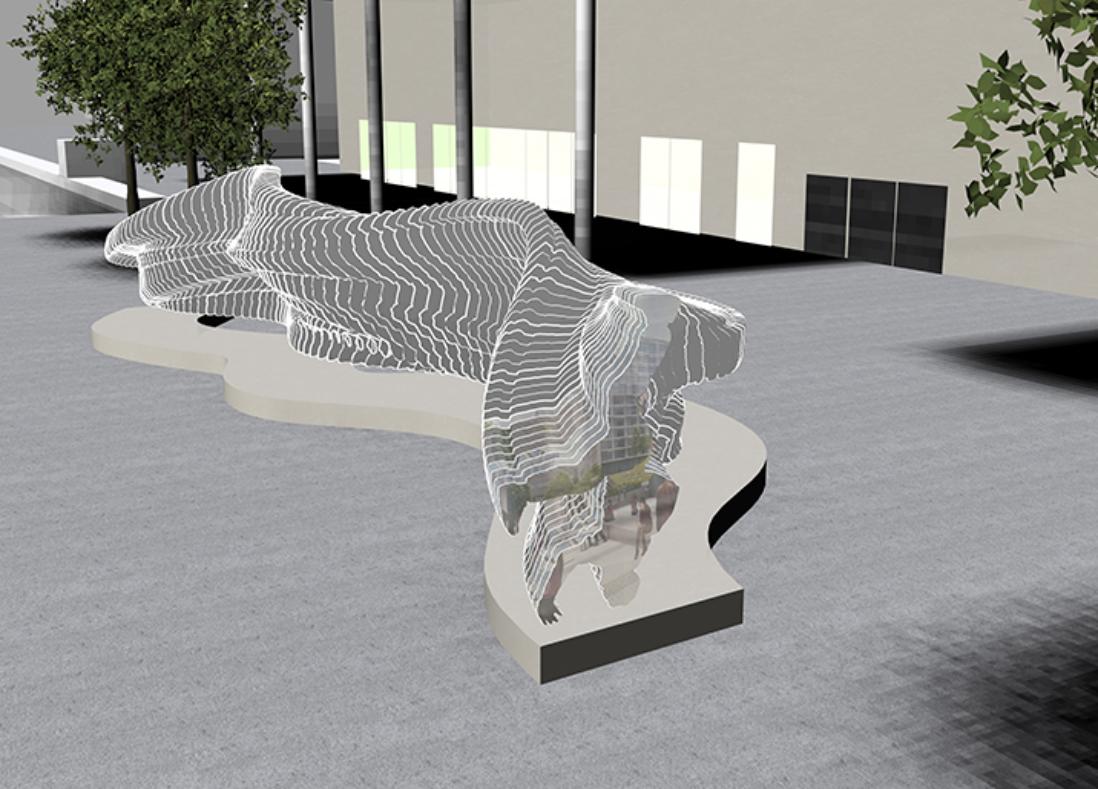
Stump series, 2019–2025
The stump is a recurring theme in my work: a habitat, a meeting place and an image of roots that connect us across time.
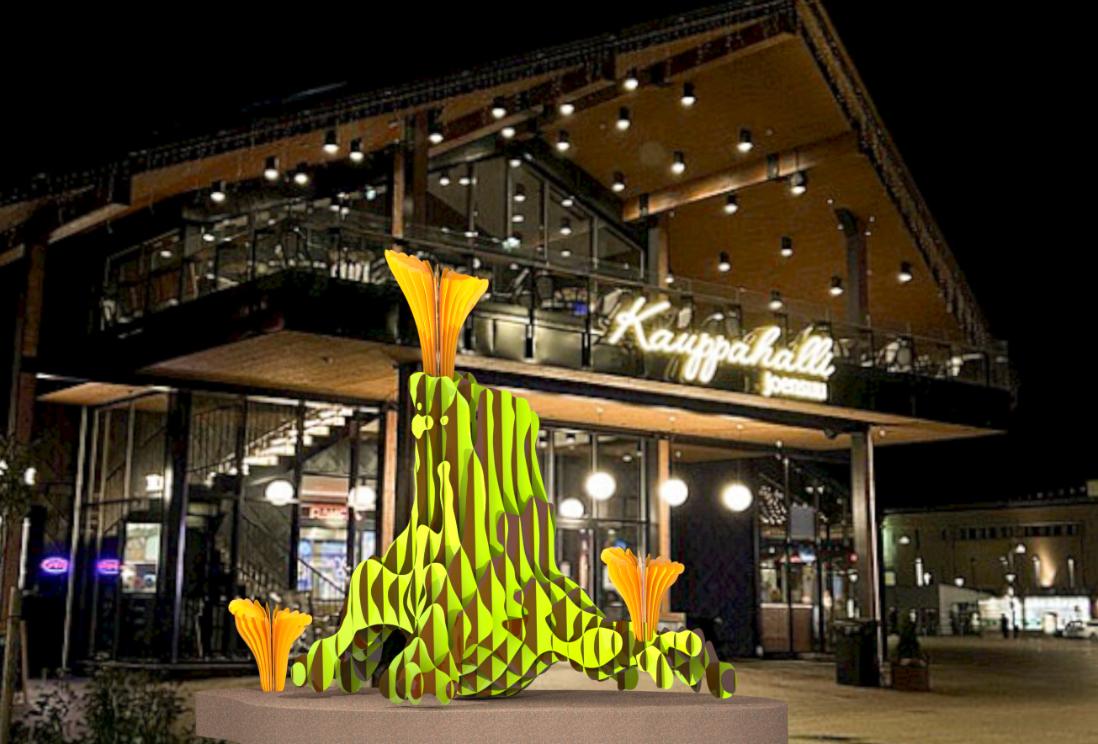
Juurikka
Place: Proposal for Joensuu Market Hall, 2025
Material: Laser-cut aluminium, painted
Size: H 4300 x W 4800 x D 3100 mm
Juurikka takes its form from an old, moss-covered stump with heavy, tentacle-like roots. When a tree dies, the stump remains and life goes on. A rotting stump is home to hundreds, even thousands, of endangered birds, insects and fungi. It stores carbon and slows climate change. A hiker finds a place to rest on a stump, and the low base of the sculpture is made for sitting.
The sculpture is made of interlocking, streamlined aluminium plates, painted in two shades. As the viewer moves, the colours shift from moss green to the red of pine bark. It is a labyrinth of colours, light and shadow, with bright fungi growing from the roots.
An old Karelian saying goes: “Istuu kun juurikka, ei lekaha.” It sits like a stump and doesn’t budge.
Unrealised proposal. Design © Satu-Minna Suorajärvi.
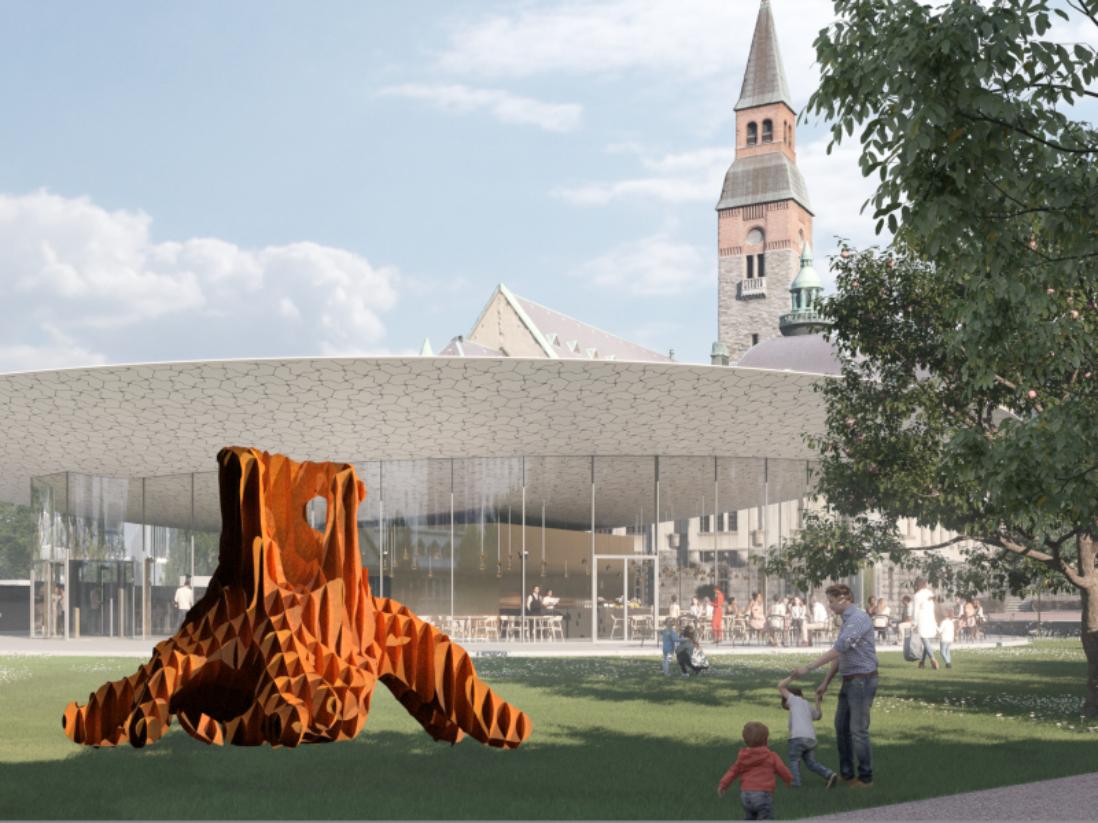
Juurakko, Roots
Place: Proposal for the new extension of the National Museum of Finland, Helsinki, 2023
Material: Cor-Ten steel
Size: H 3500 x W 6000 x D 4600 mm
Roots takes its form from an old stump with heavy, tentacle-like roots. When we talk about culture, we often speak of its roots: they reach far into the past and connect us across generations. Culture lives deep within us, and its branches spread through everything we do together. The National Museum keeps and passes on this heritage.
The sculpture was planned for the large courtyard in front of the new extension, Atlas, with its roots reaching towards the nourishing, bowl-shaped building. Its natural form relates to the National Romantic main building, while its digitally created form language looks to the future.
The sculpture is made of interlocking, streamlined plates of weathered Cor-Ten steel. It is massive in form but light in structure: a labyrinth of light and shadow, a puzzle in which every piece is needed. Roots reminds us that together we are more than the sum of our parts.
Unrealised proposal. Design © Satu-Minna Suorajärvi.
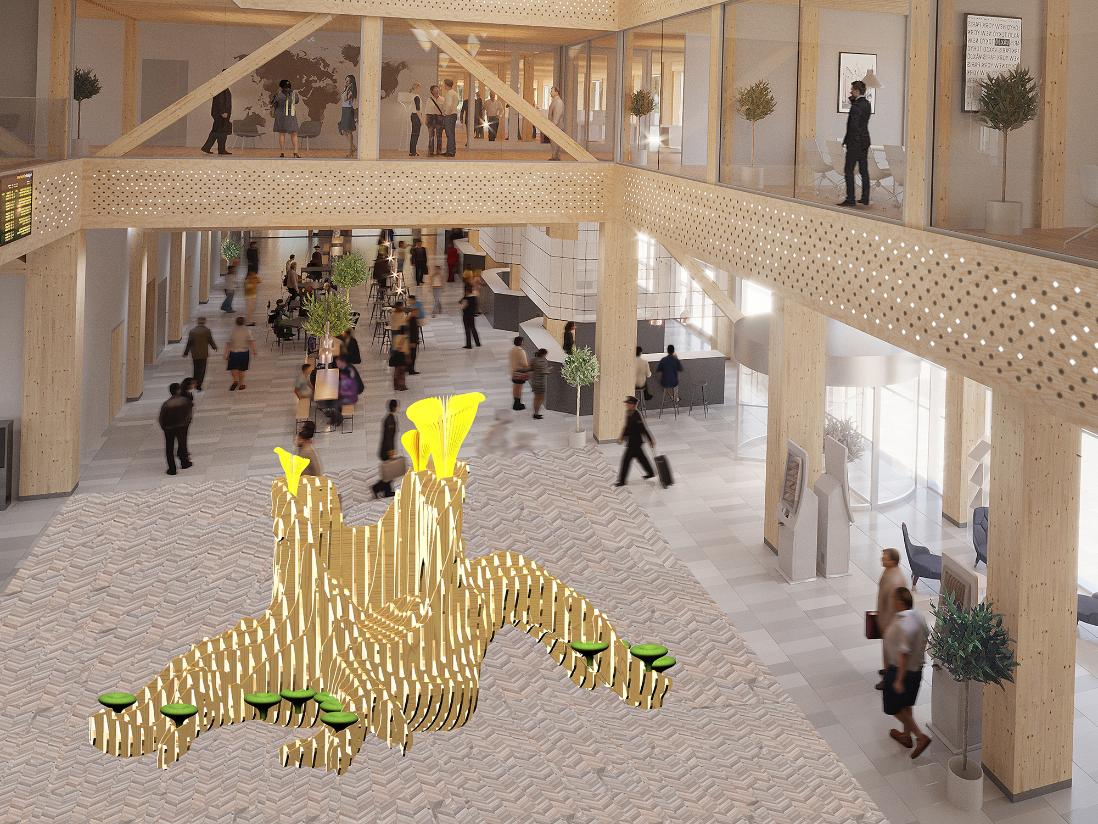
Life Around a Stump
Place: Proposal for Växjö station, Sweden, 2019
Material: Birch wood
Size: H 3750 x W 7000 x D 4500 mm
Life Around a Stump was planned for the heart of Växjö station, a timber building and an example of sustainable construction. The sculpture is a meeting place and a place to pause. You can sit on it, let your thoughts wander and look at the wooden building around you. Wood appears twice: as a stump returning to nature, and as a material turned into living architecture.
In the forest, an old stump is a vital habitat. It is home to millions of insects and fungi that live on one another and on the decaying wood. Nature cannot run its course without rotting stumps, insects and fungi at the base of the food chain.
The sculpture is built from birch wood in a waffle structure, a labyrinth of hollows where light flows in. Fungi grow from the stump: bright yellow at the top, green brackets lower down. From the light and dark hollows, the best ideas can emerge. Submitted to the same competition as Skydiving, which won first prize and was completed in 2021.
Unrealised proposal. Design © Satu-Minna Suorajärvi.
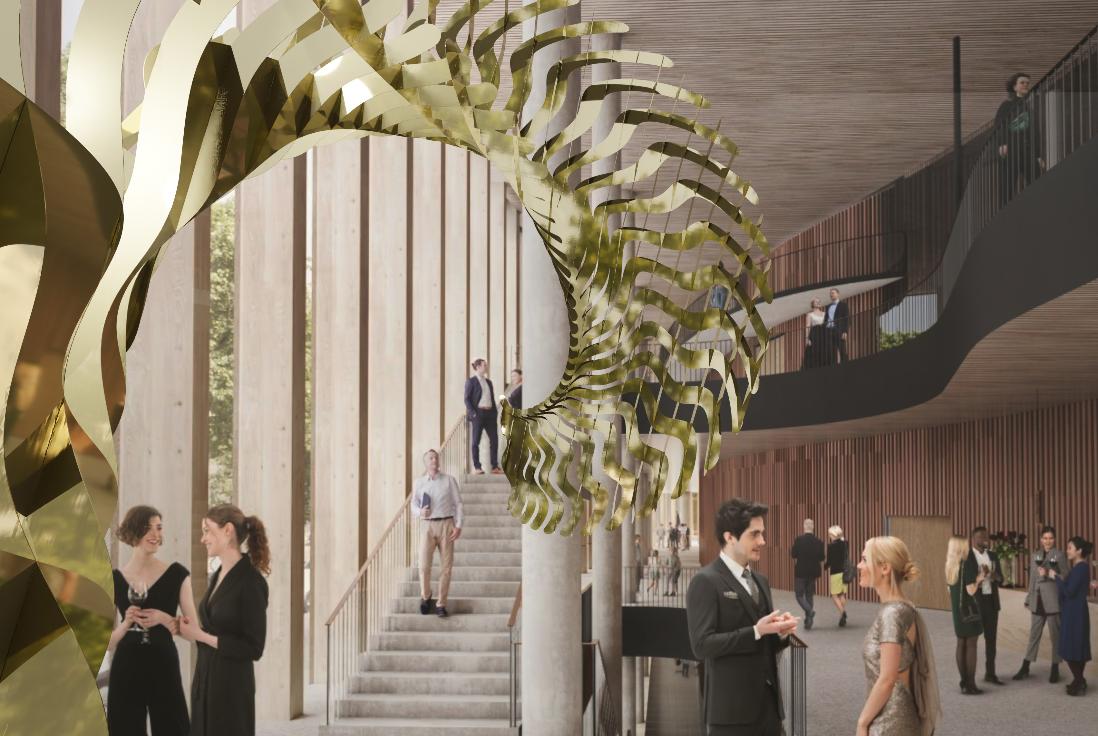
Spiral Code
Place: Proposal for Fuuga Music House, Turku, 2023
Material: Brass
Size: H 3400 x W 7000 x D 3100 mm
The starting point of Spiral Code is the spiral, one of the most common forms in nature. It appears in galaxies and snail shells, in fingerprints, ferns, sunflowers and pineapples. Plants grow along a spiral, each new cell forming after a small turn from the one before.
The spiral is also the basis of the golden ratio, drawn from the Fibonacci numbers, and the same proportions run through Western harmony and musical scales. A piano octave has 13 keys: 8 white and 5 black.
The sculpture is a wave front that turns through the hall of Fuuga, hanging above the foyer. Its wave-like brass parts cross one another and weave together into a single shimmering form, a labyrinth of light and shadow. The light changes it through the day, and as visitors move, new views open in its reflecting surfaces. Brass, the material of wind instruments for centuries, gives warmth alongside the wood and dark surfaces of the building.
Unrealised proposal. Design © Satu-Minna Suorajärvi.
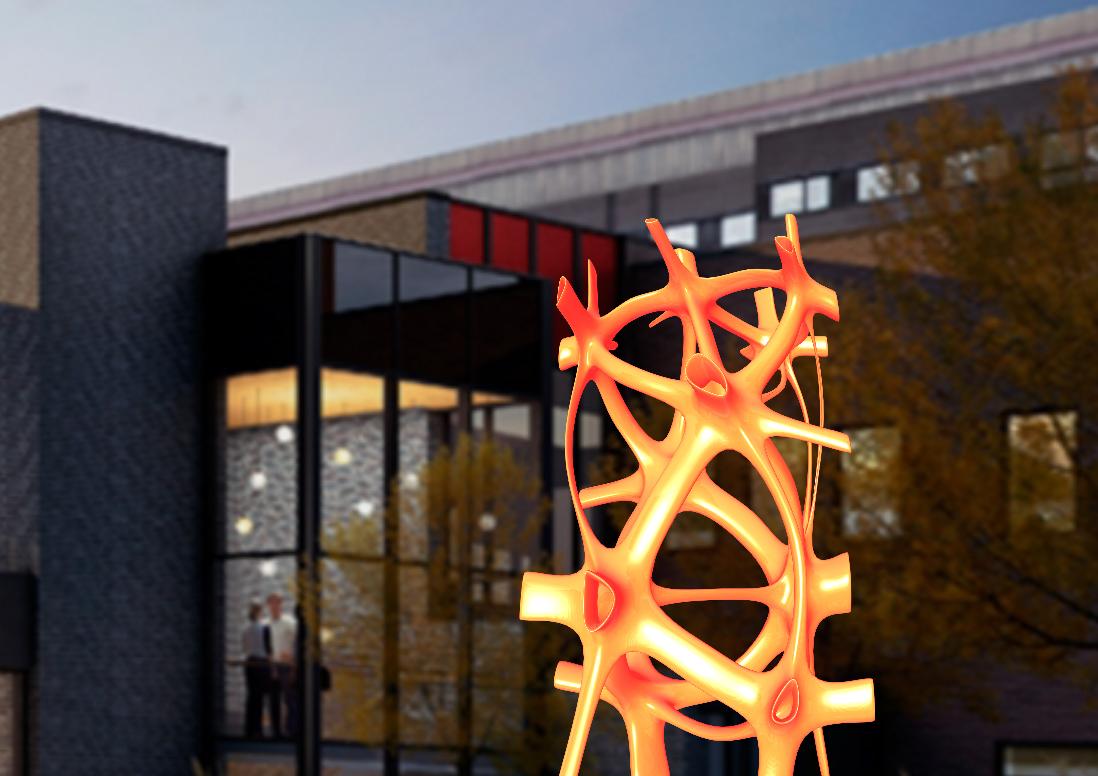
Matrix
Place: Proposal for Värnamo Hospital, Sweden, 2019 Material: Aluminium Size: H 2000 x W 1250 x D 1250 mm
Matrix means a place or medium where something is produced: a mould, a mother, a womb. It also means the environment or the set of conditions in which something grows.
The idea comes from biology. A matrix is the tissue in which more specialised structures are embedded, like the inner structure of bone and connective tissue. Similar logic appears in corals and sponges. The sculpture grows as a network of cells, open and branching. It is an image of the body’s hidden structure that holds and carries us.
The sculpture was planned for the south entrance of the hospital. Its luminous orange surface responds to the colours of the surrounding buildings and landscape.
Unrealised proposal. Design © Satu-Minna Suorajärvi.
Hip Hop
Place: Proposal for Tripla, Pasila, Helsinki, 2016
Material: Laser-cut stainless steel, mirror-polished
Size: L 12 000 × H 1 700 mm
Hip Hop draws on street culture. The sculpture is built from the silhouettes of hip hop dancers. As one silhouette changes into the next, the sculpture grows into a long, wave-like, horizontal form with the pulse of a dance.
The form was modelled parametrically, and the final shape was found by varying the movement step by step. It is divided into 115 mirror-polished steel plates. You can see through them, and they reflect the people and the city around them.
The sculpture was planned for Fredrikanterassi, the long terrace of Tripla, where it would follow the movement of people passing by.
Unrealised proposal. Design © Satu-Minna Suorajärvi.